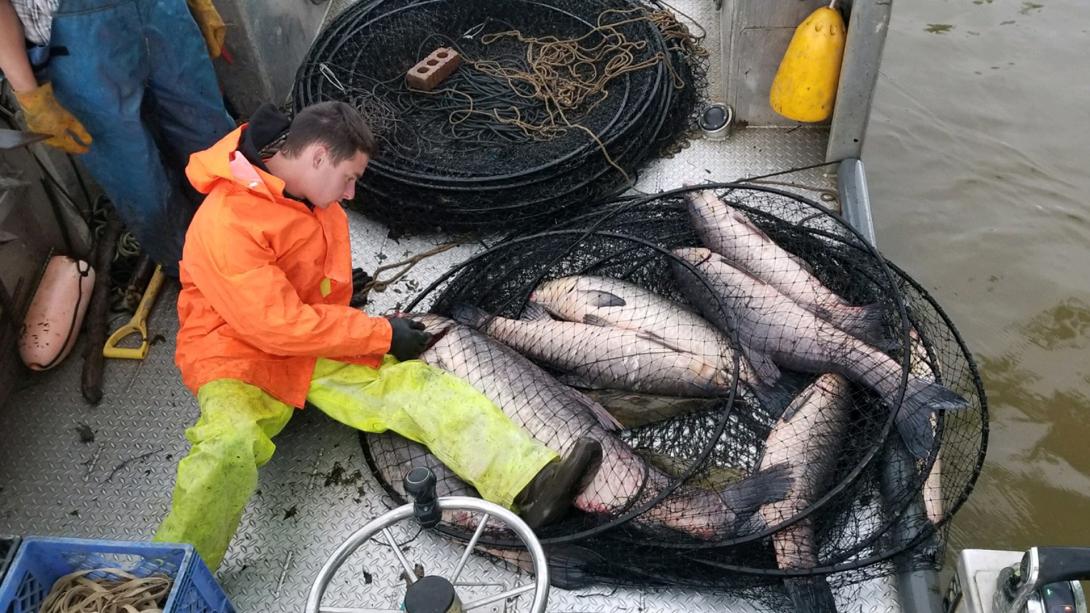
In an effort to learn more about invasive black carp, state and federal fisheries partners are expanding the scope of a bounty program to more broadly engage commercial fishers in providing black carp for research. Because black carp are rarely caught, less is known about this species compared to other invasive carp in North America. Unlike other invasive carps, black carp live near the riverbed and feed primarily on mussels and snails, a cause for concern given freshwater mussels are the most imperiled group of animals in North America.
State partnerships with commercial fishers have provided opportunities to learn more about black carp. Most of what we know comes from specimens provided by commercial fishers during the last 10 years as part of the bounty program. The majority of these have been caught incidentally when commercial fishers are harvesting other species using hoop nets. Of nearly 1,000 captures under the bounty program, less than 1% have been harvested with recreational fishing gear. Black carp have been captured from the shared waters of eight states (Arkansas, Illinois, Indiana, Kentucky, Louisiana, Mississippi, Missouri and Tennessee), primarily in parts of the lower Mississippi River, lower Illinois River and lower Ohio River.
The black carp bounty program began as part of the Invasive Carp Regional Coordinating Committee’s efforts to protect the Great Lakes, given the black carp’s presence in the lower Illinois River and the potential for upstream migration toward Lake Michigan. The bounty was initially offered in Illinois and adjoining states and is expanding to cover most of the Mississippi River basin, with 27 states now participating. The bounty program offers $100 per individual black carp, with up to 10 reimbursements per month. Although open to anyone, states are particularly interested in engaging more commercial fishers in the bounty program because commercial gear and techniques are much more effective in catching black carp.
To support the program expansion, a new “Keep, Cool, Call” webpage assists fishers with distinguishing black carp from other species, offers simple guidance on eligibility for the bounty and provides a state-by-state contact list. Proper fish identification is crucial because some protected species look similar to black carp. Fishers are strongly encouraged to familiarize themselves with this information prior to any capture effort.
Scientists and fisheries managers want to collect more information on the black carp’s age and growth and assess its distribution and abundance. Federal partners have already gained information about the species’ diet and reproduction in parts of the Mississippi River from studying the specimens collected to date. Information gathered from telemetry tracking and other field research is also contributing to our understanding of black carp habitat usage and movement patterns. Learn more about the collective value of black carp captures for research.
Black carp in the Mississippi River have been reported to reach up to 5 feet in length and weigh 115 pounds but are typically about 3 feet in length and 30-35 pounds. Learn more about black carp.
Since their entry into the lower Mississippi River 50 years ago, invasive carp multiplied rapidly and expanded their range, spreading north and into the major tributaries of the Mississippi River basin. Altogether, nearly 50 partners are now formally organized to carry out around 80 invasive carp management projects across both the Mississippi River and Great Lakes basins. Efforts of the Invasive Carp Regional Coordinating Committee to protect the Great Lakes are complemented by another partnership, the Mississippi Interstate Cooperative Resource Association, or MICRA, with a focus on invasive carp management in the Mississippi River basin. These are among the largest coordinated conservation efforts in North America.