Compared to other invasive carps in North America, less is known about the black carp because they are rarely caught. Black carp live near the riverbed and feed primarily on mussels and snails, a cause for concern given freshwater mussels are the most imperiled group of animals in North America.
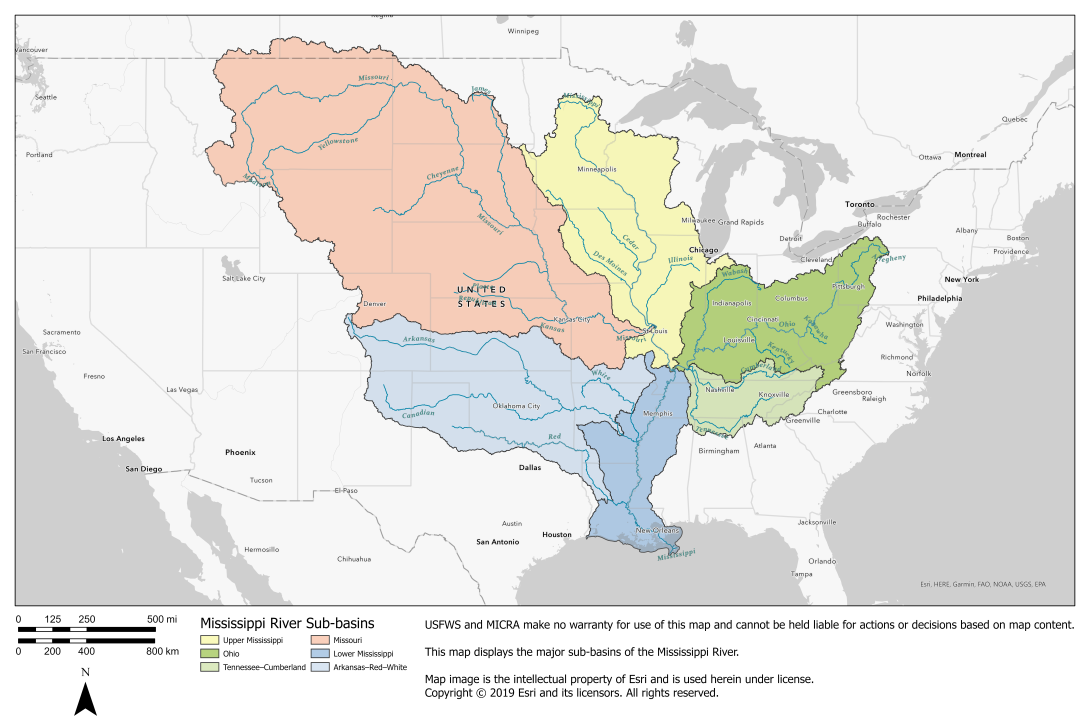
In an effort to learn more about black carp, state and federal fisheries partners offer a bounty program to more broadly engage commercial fishers in providing black carp for research. Most of what we know about black carp comes from specimens provided by commercial fishers during the last 10 years as part of this bounty program. The majority of these have been caught incidentally when commercial fishers are harvesting other species using hoop nets. Of nearly 1,000 captures under the bounty program, less than 1% have been harvested with recreational fishing gear. Black carp have been captured from the shared waters of eight states (Arkansas, Illinois, Indiana, Kentucky, Louisiana, Mississippi, Missouri and Tennessee), primarily in parts of the lower Mississippi River, lower Illinois River and lower Ohio River.
A total of 27 state agencies support the bounty program that offers $100 per individual black carp, with up to 10 reimbursements per month. Although open to anyone, states are particularly interested in engaging more commercial fishers in the bounty program because commercial gear and techniques are much more effective in catching black carp. Proper fish identification is crucial because some protected species look similar to black carp. Fishers are strongly encouraged to familiarize themselves with the identification information provided below prior to any capture effort.
Scientists and fisheries managers want to collect more information on the black carp’s age and growth and assess its distribution and abundance. Federal partners have already gained information about the species’ diet and reproduction in parts of the Mississippi River from studying the specimens collected to date. Information gathered from telemetry tracking and other field research is also contributing to our understanding of black carp habitat usage and movement patterns.
The information on this webpage is available as a fact sheet. Find the Keep, Cool, Call: What to do if you capture a black carp information along with other helpful fact sheets on our fact sheets page.
Your catch matters!
Your catch helps scientists collect valuable biological data on this invasive species which aids management efforts. The U.S. Geological Survey Nonindigenous Aquatic Species Database is used to track captures of black carp and other invasive species.
If you capture a black carp: Keep, cool, call
Keep
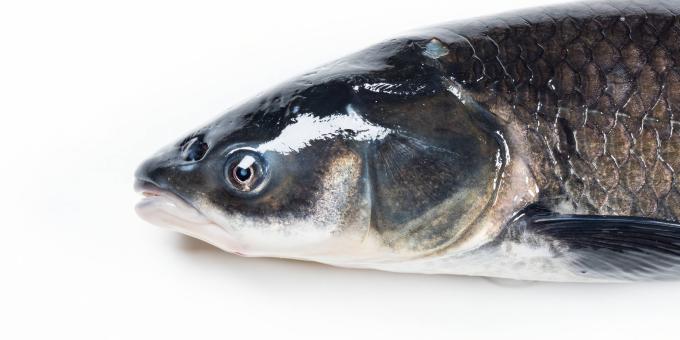
Verify the identity of the fish. If you believe your fish might be a black carp, keep the fish and make note of the location, preferably by taking GPS coordinates of the capture location. Cell phone photos of the head and mouth of the fish and the fish's total length are helpful for identification. Please note the type of fishing gear and bait you used, and if possible, habitat conditions such as substrate, depth, water temperature and flow.
Cool
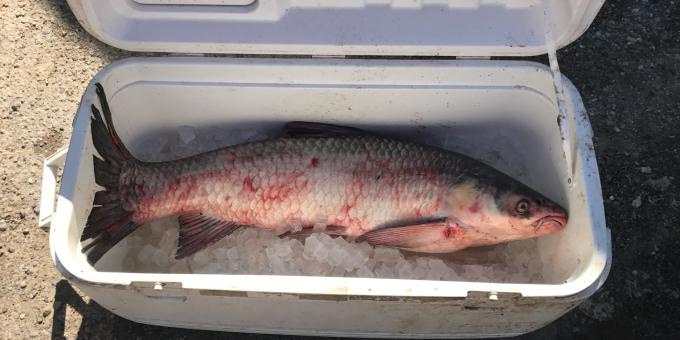
Humanely kill the fish and keep it cool on ice or in a freezer. Black carp are listed as injurious under the Lacey Act. Live possession of black carp is illegal.
Call
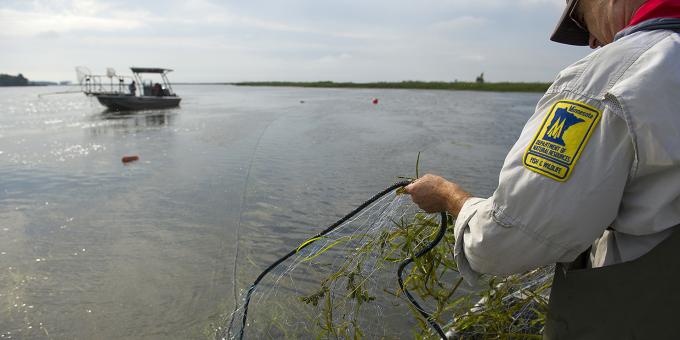
Immediately contact the appropriate state agency personnel for your state or river basin and provide them with:
- a photograph of the fish in question
- your name and contact information
- location of the capture
- type of fishing gear and bait you used
- if possible, habitat conditions such as substrate, depth, water temperature and flow.
A list of state contacts is available at the bottom of this page.
Black carp identification
Black carp and other commonly misidentified species
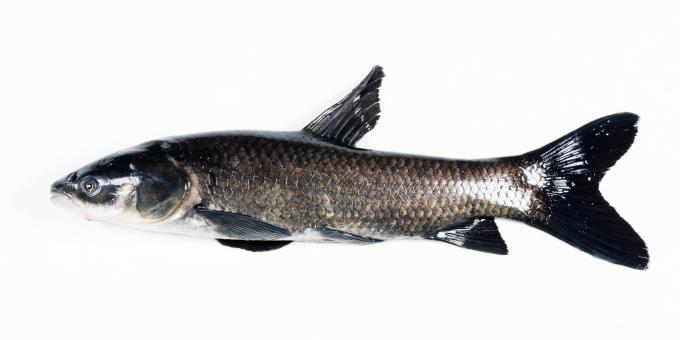
Black carp
Compared to grass carp, invasive black carp possess a longer and narrower head, darker external coloration (ranging from black to blue grey) and a nearly straight lateral line with slight decurvature midbody. When viewed from the top down the upper jaw is not visible.
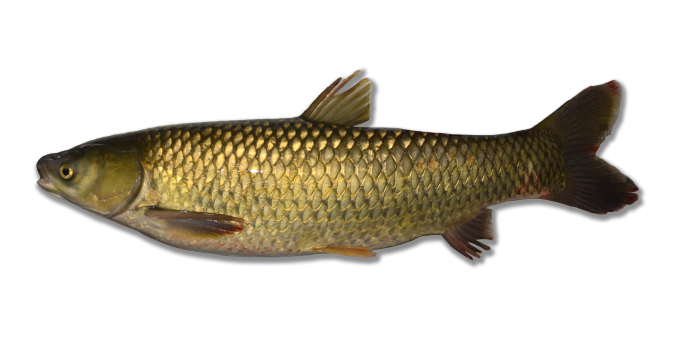
Grass carp
The upper jaw on an invasive grass carp is prominent and visible from the top down and the lateral line initially declines near the length of the pectoral fin then continues straight along the body. Grass carp are olive, silvery white or olive brown, but coloration should not be used as a primary method of identification because fish color can vary.
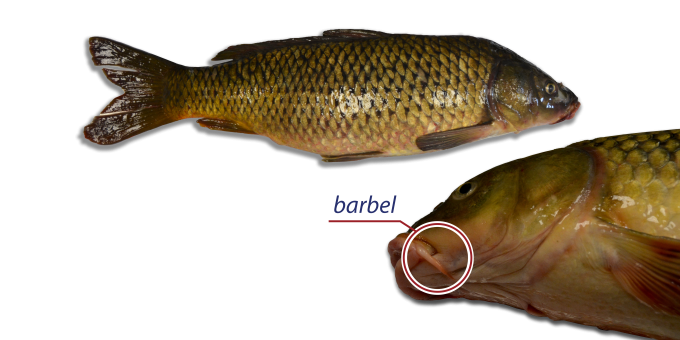
Common carp
Common carp are a non-native species that possess a single barbel at each corner of the mouth and a stockier, less elongated body than black carp.
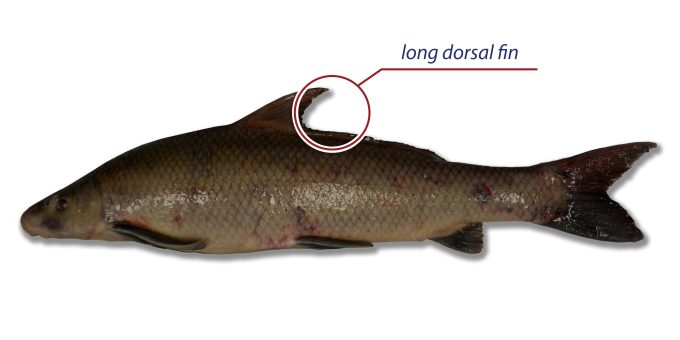
Blue sucker
Blue suckers are a native fish species protected in some waters. Blue suckers are identifiable by the long dorsal fin, elongated body, and bottom oriented or sucker mouth. Take care to identify and release blue suckers alive.

Bigmouth buffalo
Native species of buffalo, such as bigmouth buffalo, possess large scales and individuals’ coloration may be similar to black carp. The bodies of these fish are stockier than the more elongated black carp.
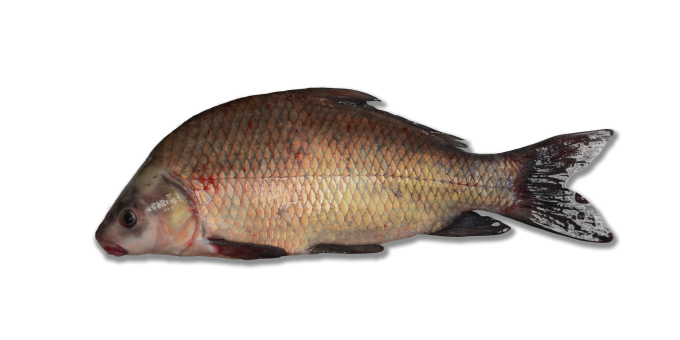
Smallmouth buffalo
Smallmouth buffalo are a native fish species with large scales and coloration that may be similar to black carp. The bodies of these fish are stockier than the more elongated black carp.
Contacts by state and river basin
Tennessee and Cumberland River Basins
Dave Armstrong
dave.armstrong@dcnr.alabama.gov
(251) 331-7050
Arkansas, Red, White and Lower Mississippi River Basins
Rachael Irby
rachael.irby@agfc.ar.gov
(501) 517-3904
Missouri River Basin
Robert Walters
robert.walters@state.co.us
(303) 291-7833
Tennessee and Cumberland River Basins
Jim Page
jim.page@dnr.ga.gov
(912) 285-6485
Upper Mississippi River Basin
Sara Tripp
sara.tripp@illinois.gov
(618) 444-3078
Ohio River Basin
Craig Jansen
cJansen1@dnr.in.gov
(812) 827-2836
Missouri and Upper Mississippi River Basins
Kim Bogenschutz
kim.bogenschutz@dnr.iowa.gov
(515) 290-0540
Joel Born
joel.born@dnr.iowa.gov
(515) 218-4554
Missouri River Basin
Chris Steffen
chris.steffen@ks.gov
(785) 230-2033
Ohio River Basin
Jeff Herod
jeff.herod@ky.gov
(270) 978-5377
Tennessee and Cumberland River Basins
Joshua Tompkins
joshua.tompkins@ky.gov
(270) 226-4192
Upper Mississippi River Basin
Grace Loppnow
grace.loppnow@state.mn.us
(651) 259-5670
Tennessee and Cumberland River Basins
Dennis Riecke
dennis.riecke@wfp.ms.gov
(601) 432-2207
Missouri and Upper Mississippi River Basins
Joe McMullen
joe.mcmullen@mdc.mo.gov
(314) 606 -5260
Missouri River Basin
Eileen Ryce
eryce@mt.gov
(406) 444-2449
Missouri River Basin
Kristopher Stahr
ngpc.ais@nebraska.gov
(402) 471-7602
Tennessee and Cumberland River Basins
Doug Besler
doug.besler@ncwildlife.org
(828) 803-6032
Missouri River Basin
Ben Holen
bholen@nd.gov
(701) 368-9117
Ohio River Basin
John Navarro
john.navarro@dnr.ohio.gov
(614) 265-6346
Arkansas, Red and White River Basins
Erika Sarvela
erika.sarvela@odwc.ok.gov
(580) 596-8025
Ohio River Basin
Mike Depew
mdepew@pa.gov
(814) 445-3454
Missouri River Basin
Tanner Davis
tanner.davis@state.sd.us
(605) 367-5244
Tennessee and Cumberland River Basins
Cole Harty
cole.r.harty@tn.gov
(629) 702-0324
Red River Basin
Monica McGarrity
monica.mcgarrity@tpwd.texas.gov
(512) 552-3465
Ohio, Tennessee and Cumberland River Basins
Jeff Williams
jeff.williams@dwr.virginia.gov
(276) 783-4860
Ohio River Basin
Katherine Zipfel
katherine.j.zipfel@wv.gov
(304) 420-4550
Upper Mississippi River Basin
Greg Sass
gregory.sass@wisconsin.gov
(715) 891-1875
Missouri River Basin
Reed Moore
reed.moore@wyo.gov
(307) 290-2828
Additional contacts
U.S. Fish and Wildlife Service - Columbia Fish and Wildlife Conservation Office
Jeremiah Smith
jeremiah_smith@fws.gov
office: (573) 306-5889
cell: (573) 864-7301
Tetra Tech
Josh Mitchell
josh.mitchell1@tetratech.com
(217) 969-2045
Illinois Department of Natural Resources
Invasive Species
dnr.ans@illinois.gov