The State of Illinois’ invasive carp management program is on the cusp of a major milestone, nearly reaching the 50-million-pound mark for invasive carp removed from the Illinois River over the last 15 years. A total of more than 7 million pounds were removed in 2025 through two separate but complementary invasive carp mass removal projects on the Illinois River, meeting the goals set in the 2025 Invasive Carp Regional Coordinating Committee Action Plan.
The growing volume of removed fish in recent years reflects the knowledge and understanding partners are gaining from a suite of projects to protect the Great Lakes from the threat of invasive carp. Projects focused on monitoring the distribution, abundance, congregating habits and movement of invasive carp populations are helping to continually improve the effectiveness of removal.
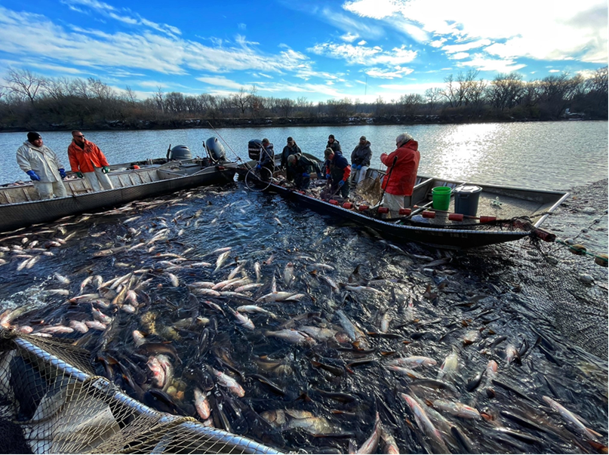
This year’s total figure of more than 7 million pounds includes more than 1.2 million pounds removed by commercial fishers working on contract with fish biologists from the State of Illinois on a stretch of the upper Illinois River comprising most of the Starved Rock, Marseilles and Dresden Island pools. This removal effort is targeted in the area surrounding the adult population front for silver carp and bighead carp located within the Dresden Island pool about 50 miles from Lake Michigan. From this effort’s inception in 2010 through 2025, more than 17 million pounds of invasive carp have been removed from the upper Illinois River.
Another larger removal effort, enhanced by a state harvest incentive program for commercial fishers, covers the lower 240 miles of the Illinois River comprising the Alton, LaGrange and Peoria pools. Silver carp and bighead carp, as well as grass carp, are much more abundant in these pools and all life stages are present. This year’s total figure of more than 7 million pounds includes more than 5.8 million pounds of invasive carp removed from this area. From this effort’s inception in 2019 through 2025, more than 32 million pounds of invasive carp have been removed from these lower pools.
The upper Illinois River removal effort is designed to suppress the mostly adult populations in that area, limit their ability to reproduce and reduce migration pressure upstream towards the Electric Dispersal Barrier System located about 37 miles from Lake Michigan. Operated by the U.S. Army Corps of Engineers, the electric barrier is designed to deter fish movement through the Chicago area waterway and is currently one of the main tools used to prevent aquatic invasive species from entering the Great Lakes. The Brandon Road Interbasin Project is now under construction, combining several deterrent technologies for a more robust line of defense.
As is the case with removal on the lower river, the vast majority of invasive carp removed from the upper Illinois River in 2025 were silver carp, with the largest volume removed from the Starved Rock pool. Silver carp, grass carp and bighead carp populations generally increase in abundance toward the Illinois River’s confluence with the Mississippi River. Black carp are also known to be present in the lower Illinois River but are captured much less frequently.
Data collection improvements are now providing a more thorough tally of the combination of invasive carp removed through state programs as well as independent commercial harvest on the Illinois River going back as far as the year 2000. When the numbers for these two state programs are combined with independent commercial harvest over 25 years, it brings the total pounds of invasive carp removed from the Illinois River to more than 106 million.
Since their entry into the lower Mississippi River 50 years ago, invasive carp multiplied rapidly and expanded their range, spreading north and into the major tributaries of the Mississippi River basin. Altogether, nearly 50 partners are now formally organized to carry out around 80 invasive carp management projects across both the Mississippi River and Great Lakes basins. Efforts of the Invasive Carp Regional Coordinating Committee to protect the Great Lakes are complemented by another partnership, the Mississippi Interstate Cooperative Resource Association, or MICRA, with a focus on invasive carp management in the Mississippi River basin. These are among the largest coordinated conservation efforts in North America.